
Mathematical Reasoning · 2025
2025 CMO Official AI Track
Intern-S1 scored 102/126 in the Chinese Mathematical Olympiad’s first official AI test, ranking first among the three participating models and exceeding both the gold-medal and national training-team cutoffs.
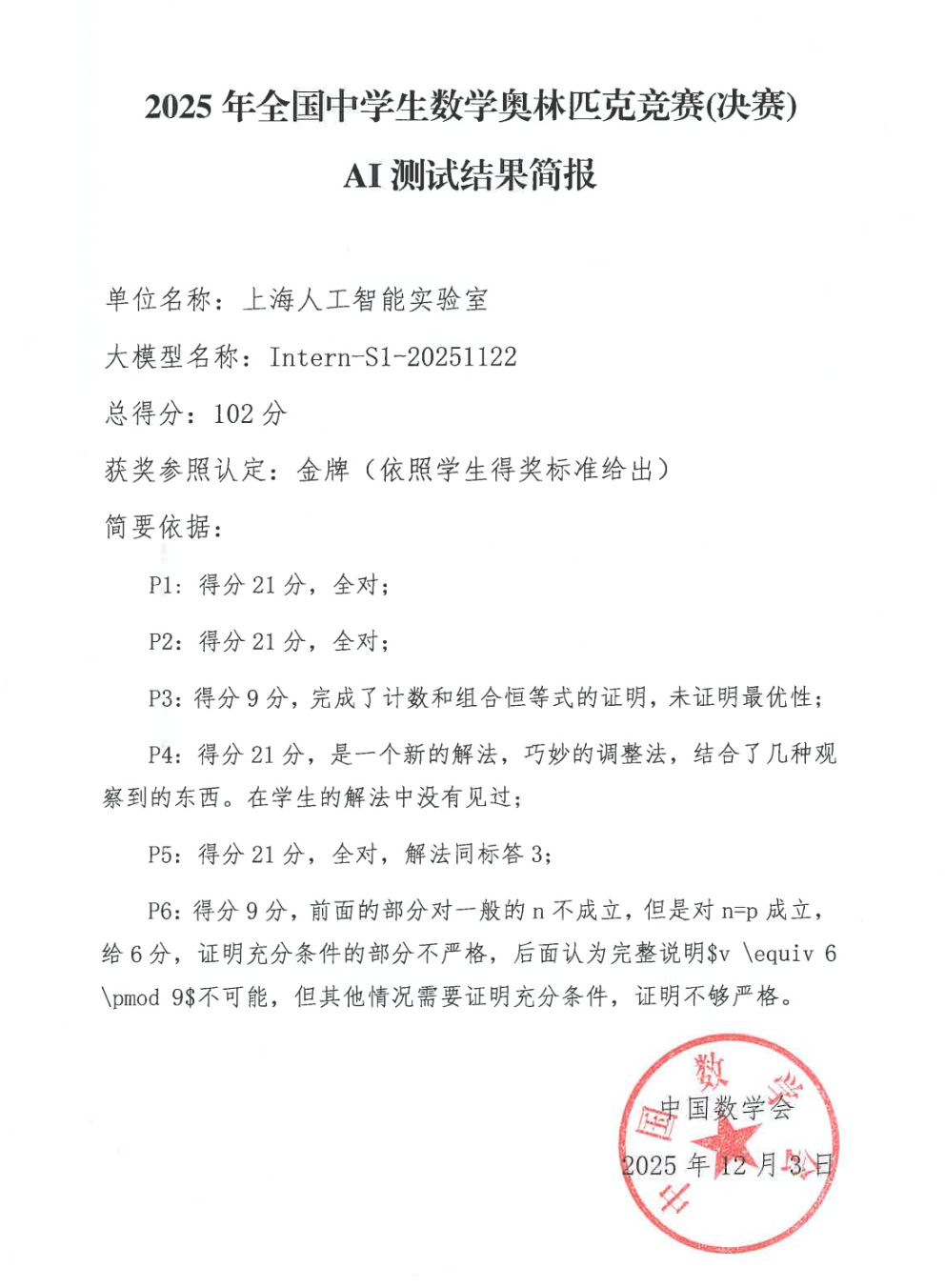
An official test of rigorous mathematical reasoning
I participated in the Intern project’s effort for the 2025 Chinese Mathematical Olympiad (CMO) official AI test. For the first time, the organizers invited three models to solve the competition problems within the same time limit as human contestants. The official judges evaluated the submissions using the same standards.
Intern-S1-20251122 scored 102 out of 126, ranking first among the participating AI models. Its score exceeded the 78-point gold-medal cutoff and the 87-point national training-team cutoff. Four problems received full marks of 21 points each; the other two received 9 points each, with deductions for incomplete optimality arguments or insufficient rigor.
Proof quality, not just final answers
CMO problems demand complete proofs across algebra, geometry, number theory, and combinatorics. Success requires coherent arguments, precise reasoning, and the ability to discover useful mathematical structure.
Judges described Intern-S1’s expression as very close to that of a human. For the fourth problem, they highlighted an ingenious adjustment argument that they had not seen in the students’ solutions. This was a concrete example of the model producing a fresh approach under official evaluation conditions.
The reasoning system behind the result
The project built on Shanghai AI Laboratory’s SAGE approach to combining general capabilities with specialized expertise. The report highlights three technical ingredients:
- Lemma-centered hierarchical reasoning: reasoning, summarization, and verification agents collaborate across multiple rounds, retaining compact, reusable mathematical lemmas.
- Outcome-based process verification: specialized verification provides supervision for the rigor of long mathematical arguments.
- General models with symbolic engines: iterative interaction with domain tools supports exploration, correction, and geometric reasoning.
The result helped motivate the subsequent move from competition problems to open research questions, including the Ghys conjecture project.
Reports and technical resources
- Shanghai AI Laboratory: 数学奥赛高分摘金,位列大模型榜首 · December 12, 2025 (Chinese)
- Technical report: multi-round hierarchical reasoning
- Technical report: outcome-based process verification
- Technical report: reasoning with symbolic engines